
TOPIC A
Countering Russian Influence and Securing the Alliance's Eastern Flank
TOPIC B
Enhancing Maritime Security
DELEGATION SIZE
Double
EXECUTIVES
Ms. Abby Vandesteeg (she/her)
Mr. Alex Rechitsky (he/him)
Ms. Stephanie Jiang (she/her)
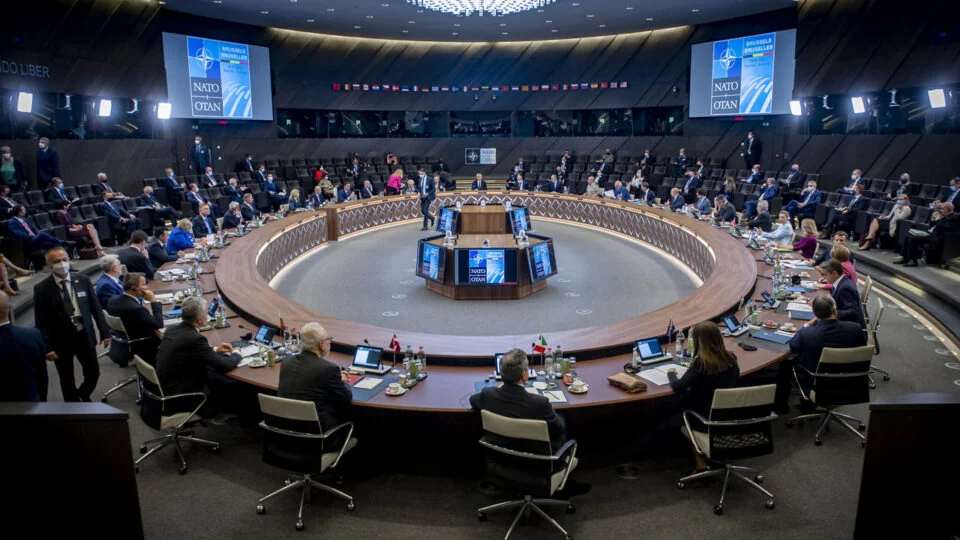
The North Atlantic Treaty Organization (NATO) was established on April 4, 1949, by twelve founding members located in North America and Europe. NATO's central mission is to guarantee the security of its constituents through political and military means. NATO operates on the principle of collective defense, meaning that an attack against one ally is considered an attack on the entire alliance.
Topic A: Countering Russian Influence and Securing the Alliance's Eastern Flank
Since its founding during the Cold War, NATO has aimed to protect its members from numerous external threats, particularly from those posed by the Soviet Union and now Russia. After the USSR's collapse, several former Soviet republics sought NATO membership to ensure their security and independence. While many have since joined, Russia has strongly opposed this expansion, claiming strategic interests in its former territories. Following Ukraine's turn toward Western aspirations, Russia intensified its efforts to undermine the country's sovereignty, most notably by seizing Crimea in 2014 and fueling separatist uprisings in the east. These actions have severely strained relations with the West. The Alliance's limited response at the time, constrained by Ukraine's non-member status, heightened security fears among Eastern European NATO states such as Poland, Romania, and the Baltic nations.
Topic B: Enhancing Maritime Security
Today, the world's oceans connect us. They are essential to global commerce and therefore, our way of life. In an era of rapid technological advancement, NATO faces the challenge of an ever-changing maritime security landscape. The Alliance has committed to strengthening their security through increasing situational awareness, allowing them to properly deter and defend against all maritime threats. This strategy includes upholding freedom of navigation, securing maritime trade routes and protecting the Alliance's main lines of communications and chokepoints. Due to the importance of global commerce, they have begun to shift their focus to securing supplies and reinforcements along transatlantic routes during crisis and conflict. As part of NATO's 2022 Strategic Concept, their overarching plan describes maritime security as the "key to our peace and prosperity." Accordingly, NATO's recent maritime activities cover all three of the Alliance's core tasks: deterrence and defence, crisis prevention and management, and cooperative security. As you begin to form your solutions and develop your ideas regarding maritime security, keep these core topics in mind.
Documents
Background GuideCommittee Members
 Albania
 Belgium
 Canada
 Croatia
 Czech Republic
 Denmark
 Estonia
 Finland
 France
 Germany
 Greece
 Hungary
 Italy
Italy Latvia
 Lithuania
 Luxembourg
 Norway
 Poland
 Portugal
 Romania
 Slovakia
 Spain
Spain Sweden
 United Kingdom
 United States